Sign up for watershed updates
By subscribing, you will receive meeting notifications, newsletters
and other information regarding water quality for the Brushy Creek Watershed.
Brushy Creek Stakeholder Meeting: September 23
Round Rock Stakeholder Meeting
Wednesday, September 23, 2026
6:00 p.m. – 7:30 p.m.
Round Rock Transportation Building: 3400 Sunrise Rd., Round Rock, TX
This meeting marks an important point in the watershed planning process. We will finalize decisions on proposed management measures, outline education and outreach initiatives, and begin to establish timelines for implementation.
For additional information or to RSVP, contact Sarah Stannard: sarah.stannard@ag.tamu.edu
Texas Watershed Stewards : November 10
Texas Watershed Stewards – Brushy Creek Watershed
Tuesday, November 10, 2026
1 p.m. to 5 p.m.
Round Rock Utilities and Transportation Building
3400 Sunrise Rd. Round Rock, TX 78664
This Texas Watershed Steward workshop on the Brushy Creek watershed will help people learn about water resources and efforts to protect local water quality. Participants will be introduced to regional watershed protection and management efforts and will learn how they can get involved.
Participants must pre-register by visiting the Texas Watershed Steward website at https://tws.tamu.edu/workshops/registration/ or by calling 979-321-5921.
For additional information please visit https://tws.tamu.edu/workshops/workshop-information/ or contact Sarah Stannard at sarah.stannard@ag.tamu.edu
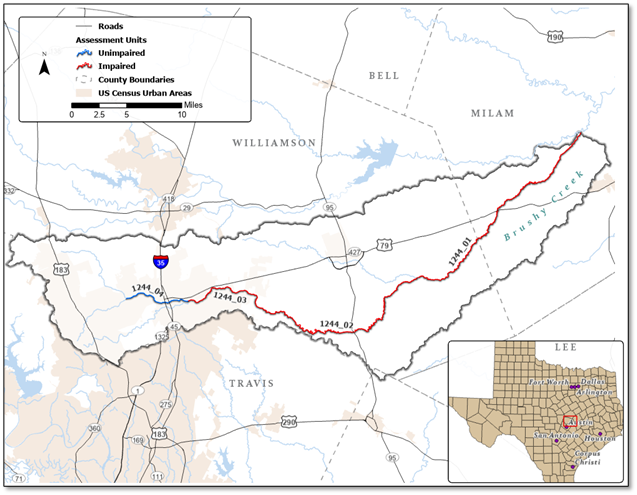
Brushy Creek comprises four Assessment Units (AUs) (1244_01 – 1244_04) and flows west to east through Williamson and Milam counties. The upstream portion of the watershed is highly urbanized, with rapidly expanding cities such as Round Rock and Hutto. Meanwhile, the downstream portion is relatively rural, but it is also experiencing rapid development and land cover change. According to the 2024 Texas Integrated Report, AUs 1244_01, 1244_02, and 1244_03 are listed as impaired due to elevated bacteria concentrations affecting primary contact recreation uses.
To support watershed planning efforts, the Texas Water Resources Institute (TWRI) secured funding from the Texas State Soil and Water Conservation Board (TSSWCB) to collect water quality and streamflow data at two locations within the watershed) between 2022 and 2026. Additionally, the Brushy Creek Characterization project, funded through the Texas Commission on Environmental Quality (TCEQ) Nonpoint Source Program, was completed in August 2025. These projects provide essential data and technical foundations for the Watershed Protection Plan (WPP) development that will begin in early 2026.
In recent years, stakeholder interest in protecting the water quality of Brushy Creek has increased significantly due to population growth and changes in land cover and land use. The Brushy Creek WPP project will expand the scope of stakeholder engagement by forming a comprehensive group of local stakeholders that appropriately represents diverse interests within the watershed. Additionally, potential stakeholder structures, such as a steering committee and workgroups, along with ground rules, will be discussed and established with the group.
TWRI will guide the stakeholder group through the process of developing and delivering a WPP for Brushy Creek that meets EPA’s Nine Key Elements for successful watershed-based plans. Stakeholders will play a crucial role in the WPP development process by providing local insights into water quality issues, identifying critical pollutant sources, and proposing feasible management measures, implementation schedule, water quality goals, and interim milestones.”